
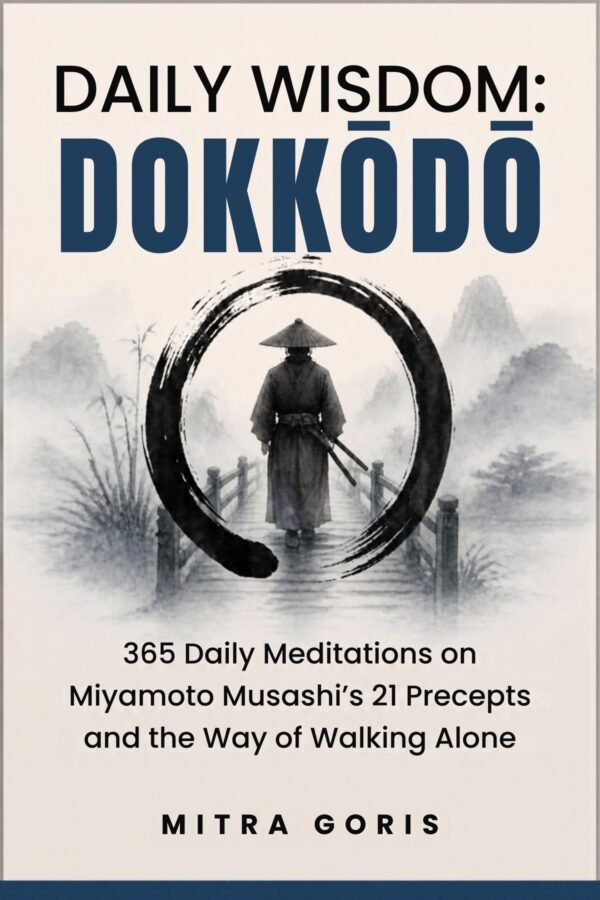
Dokkodo
Daily Wisdom: Dokkodo
365 Daily Meditations on Miyamoto Musashi's 21 Precepts and the Way of Walking Alone
Daily Wisdom: Dokkodo is a 365-day secular reading book by Mitra Goris built on the twenty-one precepts Miyamoto Musashi wrote down in 1645, one page a day.
Insight Samurai Practice Daily Mantra
As an Amazon Associate, Daily Wisdom Books earns from qualifying purchases. Some links in our articles are affiliate links; links to our own books are not.
What is inside
In the early summer of 1645, a week before he died, the swordsman Miyamoto Musashi wrote twenty-one short lines and gave them to a student. He called them Dokkodo, usually translated as The Way of Walking Alone. They are not a philosophy. They are plain first-person statements of what a man taking final stock of his life does and does not do.
This book spends a year with those twenty-one lines: one theme a month, one page each morning. Most of the precepts are refusals. I envy no one. I have no regrets. I hold no grudge and make no complaint. A modern life is crowded with exactly the things Musashi refused, which is what makes the list useful to someone who has never held a sword.
Who this book is for
This book is for the reader who is carrying too much: a grudge from three years ago, a running comparison with someone else’s life, more comfort than anyone needs and more worry about the future than it deserves. It is written for people with ordinary obligations, work, family, money, health, who have to make decisions and then live with them.
It is not a martial arts book. No martial practice is required and none is taught. The samurai appears where he clarifies something and is left alone where he does not.
What does one day look like?
Each day opens with a passage, then Insight, then Samurai Practice, then Daily Mantra. This is the passage that opens the first day of January, the month built on the first precept, “I do not go against the way of the world.”
Thus, whatever the sources, the essential principles which Bushido imbibed from them and assimilated to itself, were few and simple. Few and simple as these were, they were sufficient to furnish a safe conduct of life even through the unsafest days of the most unsettled period of our nation’s history.
Inazo Nitobe, Bushido: The Soul of Japan, Chapter II: Sources of Bushido (thirteenth edition, 1908, public domain)
The insight that follows puts that into an ordinary morning: the quiet argument most of us start the day with, against the weather, the inbox and the body that slept badly. The practice is one small thing: before you get out of bed, write down three facts about today that you cannot change, plainly, without a complaint attached. The mantra is one line: “I start from where I stand.”
How is the year arranged?
The twenty-one precepts are divided across twelve months, and each month has a name.
| Month | Theme |
|---|---|
| January | The Ground |
| February | Steadiness |
| March | The Right Size of Self |
| April | Desire |
| May | Appetite |
| June | What Is Behind You |
| July | The Poisons |
| August | Things |
| September | What Shapes You From Outside |
| October | What You Cannot Secure |
| November | Death |
| December | What Remains |
Each month opens with its precepts and a short essay, and closes with a brief reflection on the ground it covered.
What sources does this book use?
Daily Wisdom: Dokkodo quotes only public domain sources, and names the work and the chapter under every passage. Every source below can be read for free in full.
| Work | Author |
|---|---|
| Bushido: The Soul of Japan (thirteenth edition, 1908) | Inazo Nitobe |
The sourcing is worth being plain about, because it is not what the title might lead you to expect. Musashi’s own words appear in the book only as the twenty-one precepts themselves, translated for this edition from his Japanese manuscript. Every daily opening passage comes from one other book: Inazo Nitobe’s Bushido: The Soul of Japan, written in English and quoted exactly, with its chapter named beneath. Nothing is drawn from The Book of Five Rings or from Hagakure.
Nitobe is used as a thoughtful, partial witness rather than as a historian. He idealizes the samurai, and the book says so in its introduction. His sentences are prompts for practice, not proof of how samurai lived.
Frequently asked
Do I need to know anything about Musashi or the samurai first?
No. The introduction tells you who Musashi was and who Nitobe was, and every day is self-contained.
Is this the same as reading The Book of Five Rings?
No. The Book of Five Rings is Musashi’s treatise on strategy, and this book does not quote it. Dokkodo is a different and much shorter text: twenty-one lines written in the last week of his life. This book is a year of daily practice built on those lines.
Do I have to begin in January?
No. The pages are headed by month and day, but the book’s own advice is to begin where you are and trust the month you are in. If you miss days, do not go back for them. Pick up on the day you are on.
Which formats is it in?
Kindle, published on 3 October 2026, audiobook, published on 5 October 2026, and paperback and hardcover, both published on 10 October 2026. The buttons on this page list every format that exists today.
If that sounds like the year you want, it is one page a day starting whenever you open it.
As an Amazon Associate, Daily Wisdom Books earns from qualifying purchases. Some links in our articles are affiliate links; links to our own books are not.
The facts: formats, length, sources, ISBN
| Title | Daily Wisdom: Dokkodo |
|---|---|
| Series | Daily Wisdom Books, book 6 |
| Author | Mitra Goris |
| Formats | Kindle, Paperback, Hardcover, Audiobook |
| Pages | 455 |
| Published | 3 October 2026 |
| Reading time | About five minutes per day, 365 days |
| Sources | Inazo Nitobe, Bushido: The Soul of Japan (thirteenth edition, 1908) |
| ISBN | 9798161333488 (paperback), 9798161333747 (hardcover) |
Is there a companion journal?
Yes, as a free PDF. It has an entry for every day of the year, each with that day's mantra and a question written for that day's reading, so Daily Wisdom: Dokkodo itself stays one hundred percent reading rather than becoming a workbook.
It is sent to your inbox from the page whose address is printed inside the book. The printed editions are on sale separately.
Start Daily Wisdom: Dokkodo whenever you like. There is no day one.
As an Amazon Associate, Daily Wisdom Books earns from qualifying purchases. Some links in our articles are affiliate links; links to our own books are not.