
Stoicism
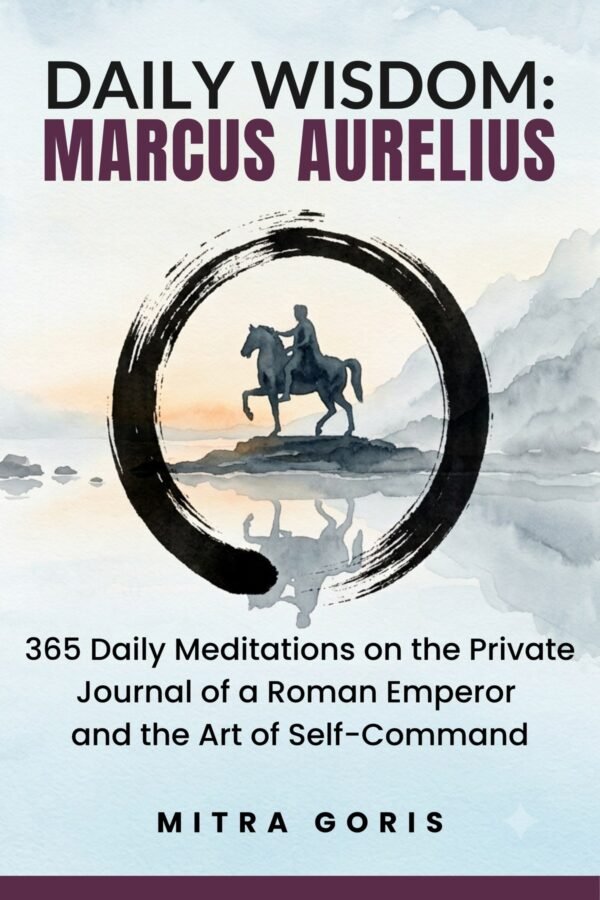
Daily Wisdom: Marcus Aurelius
365 Daily Meditations on the Private Journal of a Roman Emperor and the Art of Self-Command
Daily Wisdom: Marcus Aurelius is a 365-day secular reading book by Mitra Goris that spends a year with the Meditations of Marcus Aurelius, one page a day.
Insight Stoic Practice Daily Mantra
As an Amazon Associate, Daily Wisdom Books earns from qualifying purchases. Some links in our articles are affiliate links; links to our own books are not.
What is inside
Somewhere on the northern frontier of the Roman Empire, in a military camp along the Danube, the most powerful man in the world sat down at the end of a long day and wrote a note to himself. He was not writing a book. The notes survived anyway, and became the Meditations.
This book stays with Marcus Aurelius alone for a year. Every day’s passage comes from the Meditations and nowhere else, so that across 365 days you come to know not a school of philosophy in general but one particular person, catching himself in the same faults again and again and beginning again the next morning.
Who this book is for
This book is for the reader who is overburdened rather than lost: carrying real responsibility, often tired, and looking for something to get up to in the morning. Marcus was not a serene sage. He led an empire through war and plague, buried most of his children, and used philosophy as a tool for getting through the day rather than as a decoration.
If you want a survey of Stoicism with Seneca and Epictetus alongside him, that is Daily Wisdom: Stoicism. This volume is the other choice: one voice, all year.
What does one day look like?
Each day opens with a passage from the Meditations, cited by book and section, then Insight, then Stoic Practice, then Daily Mantra. This is the line the book takes as its epigraph, in George Long’s words.
Such as are thy habitual thoughts, such also will be the character of thy mind; for the soul is dyed by the thoughts.
Marcus Aurelius, Meditations, 5.16 (George Long translation, public domain)
The book prints its passages lightly modernized from Long’s Victorian English, so thy becomes your and the phrasing is smoothed. Where a passage is a condensed paraphrase rather than a close rendering, the book marks it “Adapted”.
How is the year arranged?
Twelve themes, one a month, moving from foundation to practice to integration.
| Month | Theme |
|---|---|
| January | The Examined Life |
| February | Perception and Judgment |
| March | The Dichotomy of Control |
| April | Mastering the Passions |
| May | Virtue as the Only Good |
| June | Amor Fati |
| July | Memento Mori |
| August | Adversity as Training |
| September | Relationships and the Common Good |
| October | Speech, Silence, and Attention |
| November | Gratitude and Sufficiency |
| December | The Inner Citadel |
Each month opens with a short essay on its theme and closes with a seven-day Stoic Challenge, a set of reflection questions and a final passage to carry forward. You do not need to do all of it. Read the day and carry one sentence.
What sources does this book use?
Daily Wisdom: Marcus Aurelius quotes only public domain translations, and names its translators in a note on the sources. Every source below can be read for free in full.
| Work | Author | Translator |
|---|---|---|
| Meditations | Marcus Aurelius | George Long |
Only Marcus’s own words are used. Meditations sometimes quotes Epictetus, Epicurus and the poets, and the book sets those borrowed lines aside. If you want the complete text, the comparison of Meditations translations explains which one to read.
Frequently asked
Is this the same as reading Meditations?
No, and it is not a substitute. Meditations is a private notebook, unstructured and repetitive by nature. This book takes 365 passages from it, arranges them into twelve themes, and attaches an insight and a practice to each one.
I have read Daily Wisdom: Stoicism. Do I need this one too?
They are different books. Stoicism introduces the whole tradition through three writers. This one draws every passage from Marcus Aurelius alone.
Do I have to begin in January?
No. The pages are headed by month and day, but the book’s own advice is to begin where you are and trust the month you are in. If you miss days, do not catch up. Return to today.
If that sounds like the year you want, it is one page a day starting whenever you open it.
As an Amazon Associate, Daily Wisdom Books earns from qualifying purchases. Some links in our articles are affiliate links; links to our own books are not.
The facts: formats, length, sources, ISBN
| Title | Daily Wisdom: Marcus Aurelius |
|---|---|
| Series | Daily Wisdom Books, book 5 |
| Author | Mitra Goris |
| Formats | Kindle, Paperback, Hardcover, Audiobook |
| Pages | 438 |
| Published | 1 September 2026 |
| Reading time | About five minutes per day, 365 days |
| Sources | Marcus Aurelius, Meditations, George Long translation |
| ISBN | 9798172182709 (paperback), 9798172301070 (hardcover) |
Is there a companion journal?
Yes, as a free PDF. It has an entry for every day of the year, each with that day's mantra and a question written for that day's reading, so Daily Wisdom: Marcus Aurelius itself stays one hundred percent reading rather than becoming a workbook.
It is sent to your inbox from the page whose address is printed inside the book. The printed edition is on sale separately.
Start Daily Wisdom: Marcus Aurelius whenever you like. There is no day one.
As an Amazon Associate, Daily Wisdom Books earns from qualifying purchases. Some links in our articles are affiliate links; links to our own books are not.