
Which Bhagavad Gita translation should you read first?
Most people meet the Bhagavad Gita through one line about doing your duty without minding the outcome. Very few learn what that line is a reply to, and it changes the book completely.
What the famous verse is actually answering
Here is the passage everybody knows, in Edwin Arnold’s 1885 verse translation:
Find full reward of doing right in right! Let right deeds be thy motive, not the fruit which comes from them.
Sir Edwin Arnold, The Song Celestial
On a mug that is serene. In the book it is an argument, and this is what it is arguing against. A few pages earlier, Arjuna is standing between two armies, looking at cousins and teachers he is about to kill, and he breaks:
So spake Arjuna to the Lord of Hearts, and sighing, “I will not fight!” held silence then.
Sir Edwin Arnold, The Song Celestial
Everything after that, including the verse on the mug, is Krishna talking him back into the battle. The Gita is not a calm book of maxims. It is a seven hundred verse argument with a man who has decided that the right thing to do is refuse.
Knowing that does not make the teaching smaller. It makes it usable. The verse is not saying outcomes do not matter. It is being said to somebody paralysed by an outcome he can picture too clearly, which is a state most readers recognise long before they recognise a battlefield.
Why the translations differ so much
Three reasons, and they compound. The Sanskrit is verse, so anything faithful to the meaning loses the music and anything faithful to the music takes liberties. The key terms have no English equivalent: dharma arrives as duty, law, righteousness or nature depending on who is holding the pen. And the Gita sits inside a living religion, so most translators are also, quietly or openly, interpreters of it.
That last one matters more here than with any other text in this series.
About the edition you have probably been given
The most widely distributed English Gita is Bhagavad-Gita As It Is, translated by A. C. Bhaktivedanta Swami Prabhupada, handed out in enormous numbers by the movement he founded. If somebody once gave you a Gita for free, it was probably that one.
It is a real translation, and it is upfront about what it is doing: every verse comes with a commentary reading the text through Gaudiya Vaishnavism, the devotional tradition Prabhupada belonged to. The book says so. The difficulty is that the commentary is most of the page, so a reader who does not notice the frame will take a particular school’s reading as simply what the Gita says.
That is worth knowing rather than worth avoiding. If you want that tradition’s Gita, it is the best possible guide to it. If you want the poem with the interpretation kept lighter, start elsewhere and come back to it.
The main translations compared
| Translator | Year | Register | Price | Best for |
|---|---|---|---|---|
| Edwin Arnold | 1885 | Victorian blank verse | Free, public domain | Hearing it as a poem, and quoting it freely |
| Kashinath Trimbak Telang | 1882 | Literal, scholarly | Free, public domain | Checking what a line says before anyone made it beautiful |
| Eknath Easwaran | 1985 | Plain prose, long introductions | Paid | A first read, with the context supplied |
| Juan Mascaro | 1962 | Spare, lyrical | Paid | Readers who want the poem and not the apparatus |
| Stephen Mitchell | 2000 | Modern, very readable | Paid | Reading it aloud, with the same caution his Tao Te Ching earns |
Which should you actually buy?
- Reading it for the first time. Easwaran. The introductions do the work of a teacher.
- Spending nothing. Arnold, free and complete on Project Gutenberg.
- Wanting the poem, unadorned. Mascaro.
- Already inside the devotional tradition. Prabhupada, read as what it is.
The three worth acting on, with what each one is for:
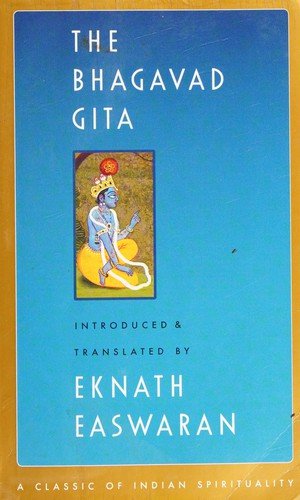
The Bhagavad Gita
Translated by Eknath Easwaran
The best first read in English. A long introduction sets up the battlefield and the argument before you meet a single verse, which is exactly what this text needs and rarely gets.
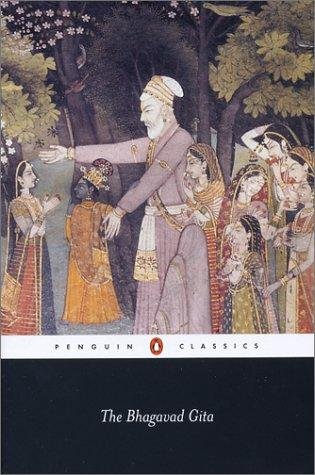
The Bhagavad Gita
Translated by Juan Mascaro
Short, lyrical and almost free of apparatus. The one to own if you would rather meet the poem directly and look things up later.
The Song Celestial
Translated by Sir Edwin Arnold, 1885
Complete, public domain and free. Victorian verse, which is either the charm or the obstacle, and the version quoted on this page for the reason that you can go and check it.
The part nobody warns you about
You have picked one. Now the thing that stops most people at chapter three.
The Gita is a philosophical argument, and arguments have to be followed. Unlike the Tao Te Ching or the Dhammapada you cannot open it anywhere and take what you find, because chapter six is answering chapter five. So it asks for a run at it, and a run at it is exactly what a reader with forty spare minutes a week does not have. The book gets started, gets shelved somewhere around the description of the disciplines, and stays there feeling like homework.
Which leaves an odd gap. The argument needs continuity, and the teaching inside it, the part you would actually use on a Tuesday, needs repetition. Those two want opposite formats.
So read the whole thing once, in a translation that helps you through it, and treat that as the argument. Then take the teaching a day at a time, which is what the book below is for. It is not another translation and it does not replace the ones above.
Ours
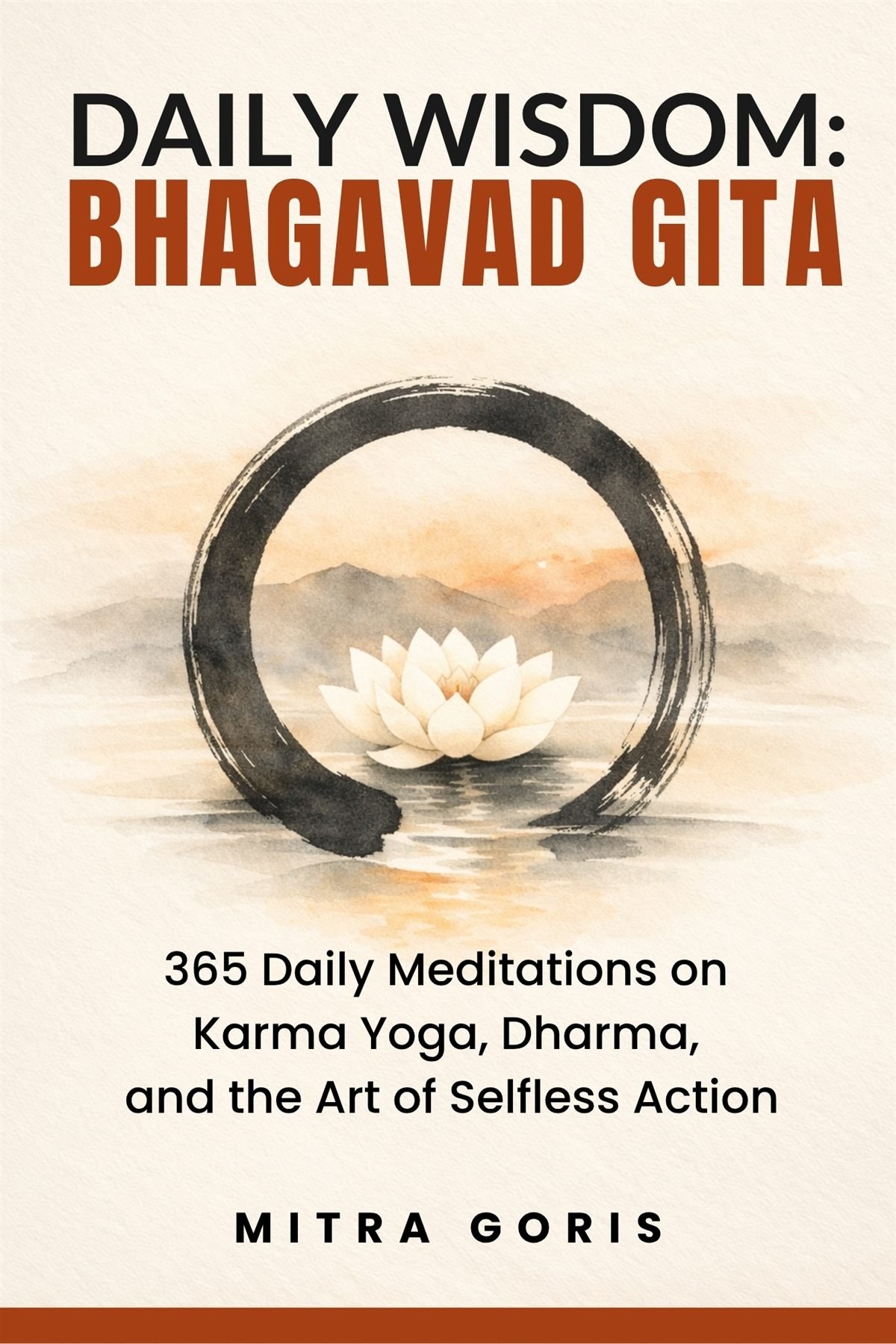
Daily Wisdom: Bhagavad Gita
Translated by One reading for every day of the year
Three hundred and sixty-five days on karma yoga, dharma and selfless action, built on the public domain translations: the passage, an Insight, a Gita Practice and a Daily Mantra.
Where can you read the Bhagavad Gita free?
Arnold’s Song Celestial is complete on Project Gutenberg, and Telang’s more literal 1882 translation is public domain too, in volume 8 of the Sacred Books of the East.
Both are used in Daily Wisdom: Bhagavad Gita, and for the usual reason: they can be quoted in full and pointed at. Arnold for the line that sings, Telang when it matters more what the verse says than how it sounds. A book that quotes a translation you cannot go and read is a closed loop.
There are comparisons here for the other three traditions too: the Tao Te Ching, the Dhammapada and Meditations.